Agricultural Reform
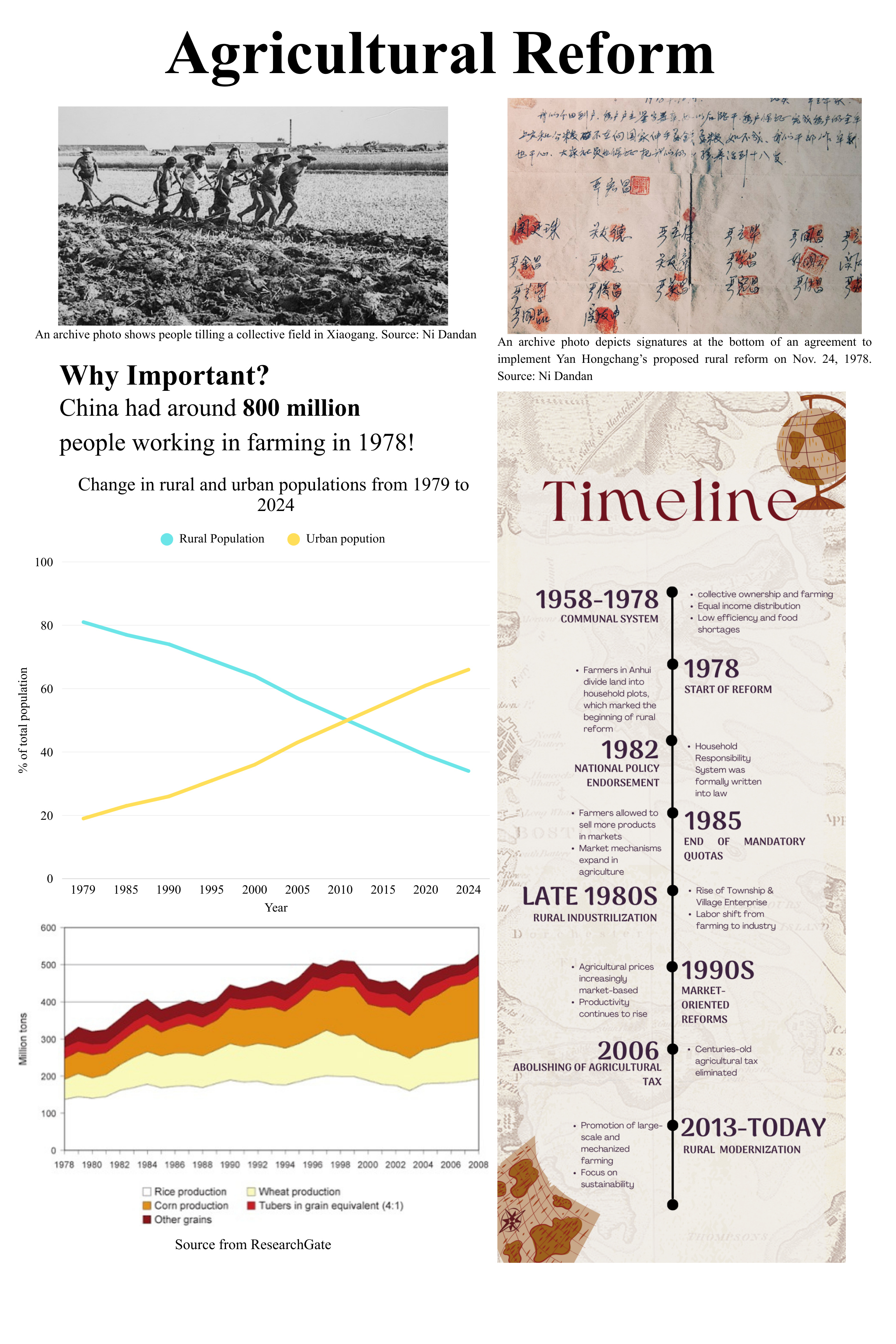
China’s agricultural reform since 1978 marked a turning point in the country’s economic and social development. Before 1978, China’s rural areas operated under the communal system, where use of land and what goods to produce were decided by local governments (Asia for Educators). Local governments were also unable to make decisions by themselves; instead, they had to follow the arrangements of the central government. Although this system aimed for efficiency, it constantly encountered problems in the actual operation process. This issue lies in the fact that under the collective agricultural model, regardless of the contribution made, people receive the same output, which dampens their enthusiasm. At that time, around 800 million people worked in agriculture, meaning any reform would affect most of the population (World Bank).
A pioneer farmer from Anhui first made changes to the communal system which became called the Household Responsibility System in 1978 (Ni). This experiment was later endorsed as national policy in 1982. Under this system, land remained collectively owned, but households were allowed to manage their own crops and keep surplus production after meeting state quotas. This policy greatly increased farmers’ motivation, leading to rapid growth in grain output and higher rural incomes (China.org)
During the late 1980s and 1990s, agricultural reform expanded beyond farming itself. Rural industrialization developed, with township and village enterprises providing jobs (Chen). As a result, labor gradually shifted from agriculture to industry and services, accelerating urbanization. The infographic shows a clear decline in the rural population and a rise in urban population after 1979.
Further reforms continued in the 2000s. In 2006, China abolished the centuries-old agricultural tax, reducing the financial burden on farmers (Our China Story). Since 2013, policies have focused on rural modernization, emphasizing mechanization, large-scale farming, technological innovation, and sustainability,
Overall, China’s agricultural reform since 1978 transformed a low-efficiency collective system into a more productive, market-oriented rural economy. It not only ensured food security but also took millions of people out of poverty.
Asia for Educators, Columbia University. “The Commune System (1950s).” Asia for Educators | Columbia University, afe.easia.columbia.edu/special/china_1950_commune.htm. Accessed 7 Jan. 2026.
Chen, Hongyi. “Township and Village Enterprises - Chinese Studies - Oxford Bibliographies.” Oxford Bibliographies, 25 Feb. 2016, www.oxfordbibliographies.com/display/document/obo-9780199920082/obo-9780199920082-0128.xml. Accessed 7 Jan. 2026
China.org. “1983: Household Responsibility System.” 1983: Household Responsibility System, 16 Sept. 2009, www.china.org.cn/features/60years/2009-09/16/content_18534697.htm.
Ni, Dandan. “The Farmer Who Changed China Forever.” #SixthTone, 21 Aug. 2018, www.sixthtone.com/news/1002783. Accessed 7 Jan. 2026.
Our China Story, “China Decided to Abolish Agricultural Tax: Today in History: Fun Fact.” Our China Story, Our China Story, 24 Dec. 2024, www.ourchinastory.com/en/13716/China-decided-to-abolish-Agricultural-Tax. Accessed 7 Jan. 2026
World Bank. “Rural Population (% of Total Population) - China.” World Bank Open Data, data.worldbank.org/indicator/SP.RUR.TOTL.ZS?locations=CN. Accessed 8 Jan. 2026.