Education
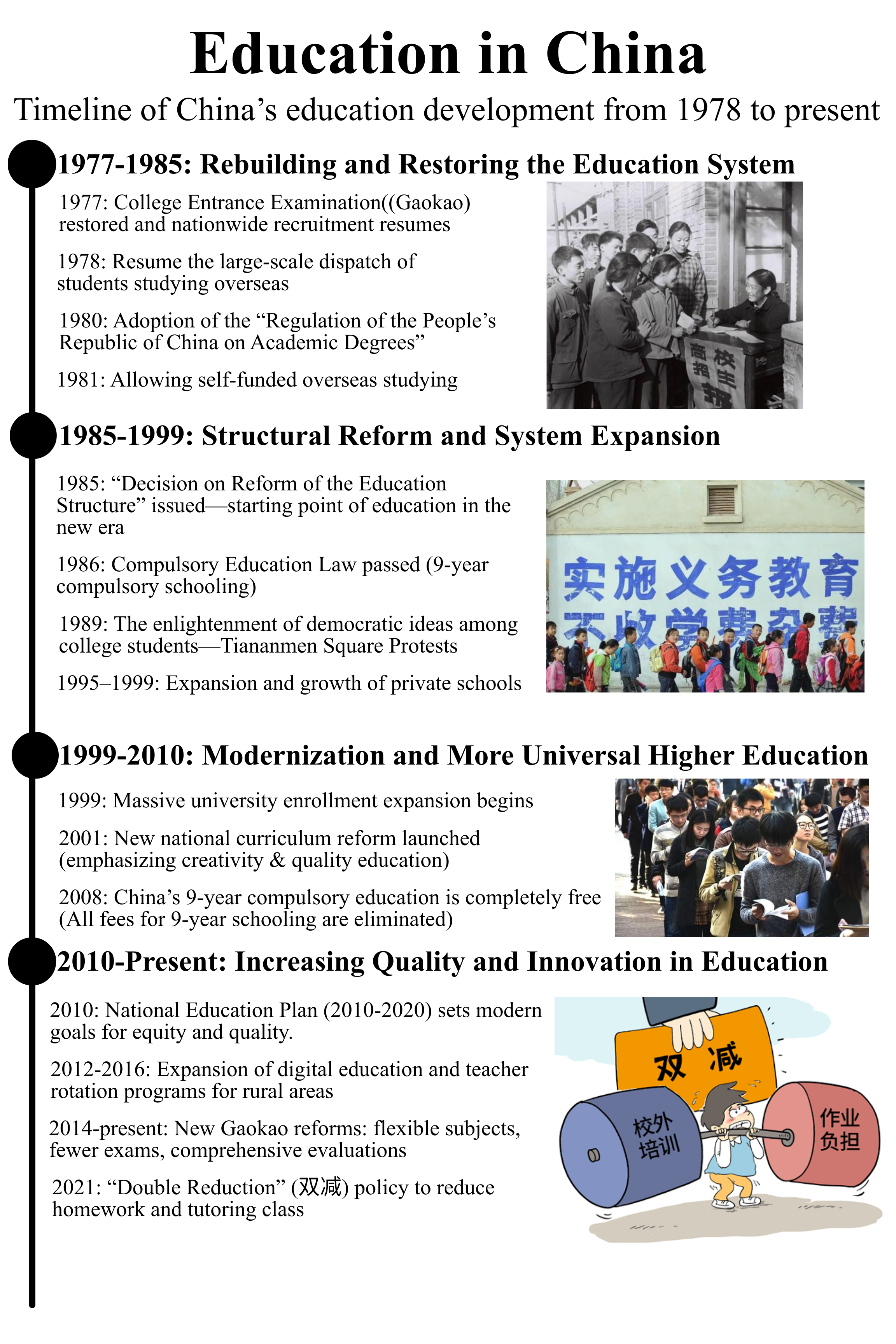
In the late 1970s, as China was under the shadow of the Cultural Revolution, classrooms across the country were silent, textbooks were destroyed, and students were forced to participate in the uprising (Lieberthal). Following Mao’s death in 1976, which marked the end of the Cultural Revolution, Gaokao returned in late 1977 by the decision made by Deng. Millions of people took the Gaokao and rushed back to school after almost 10-year no schooling (Wang). Education reform in China has been carried out amid economic reform. In 1986, an act that gave hundreds of millions Chinese young men the opportunity to receive education was implemented. From then on, the vast majority of people, who are the keystone of China today, received education. The education reform has offered China the opportunity to engage in high-tech industries, rather than low-end industries. (Sun)
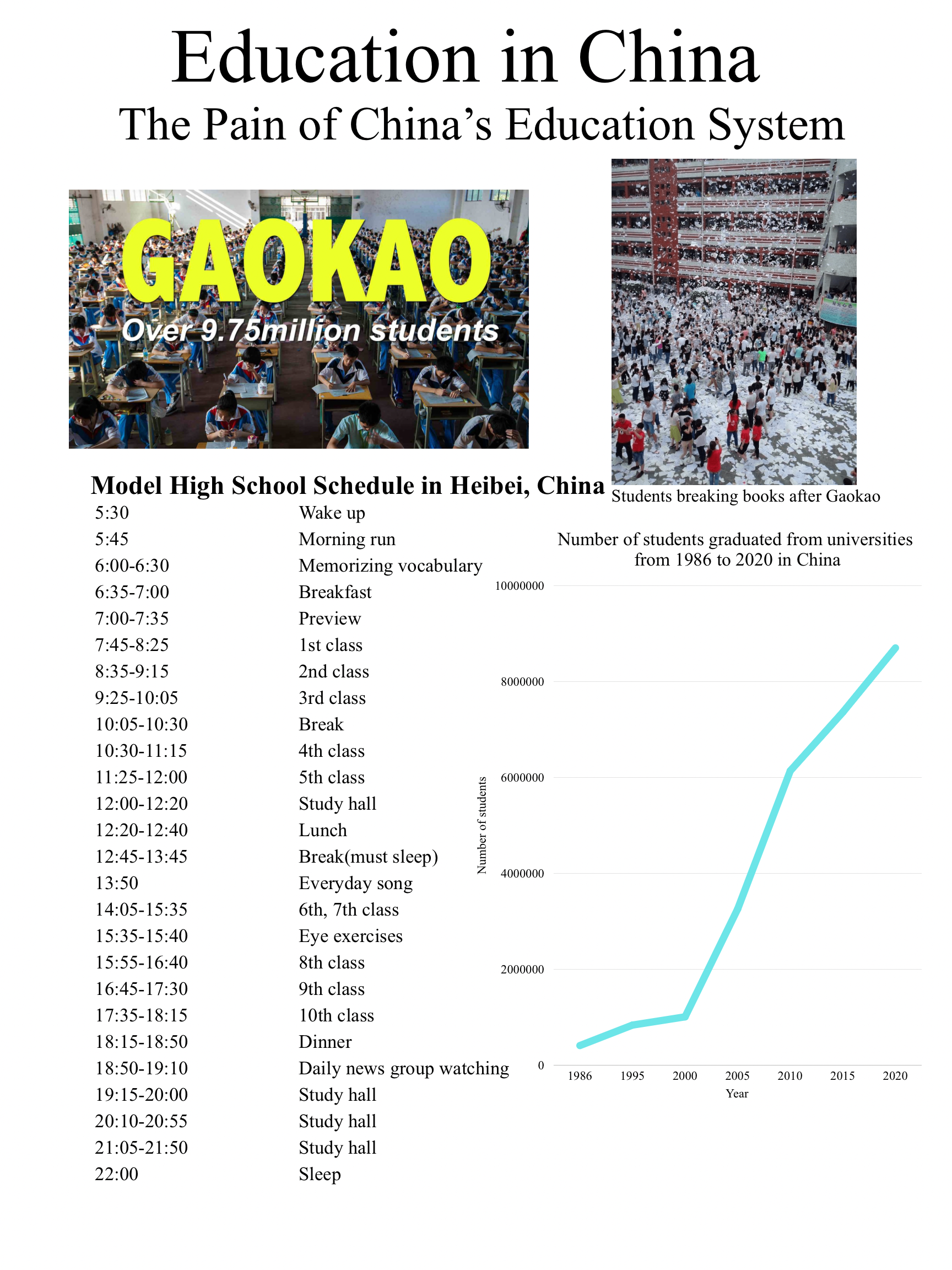
Admittedly, China’s education system after the reform significantly enhanced the educational level of society, it also brought big pain to an entire generation of students. Students in China suffered in the exam-driven education system. Teachers and parents prioritized scores over anything else such as innovation and critical thinking. In this situation, the pressure that students suffer is unbelievable. Here is a schedule of students’ daily life in Hebei-very competitive environments for Gaokao. Students were forced to wake up at 5:30am and take 10 classes per day with little break. The interesting thing is that most students obeyed or even liked this policy. Students notice Gaokao and hardworking may be their only chance to get rid of poverty and change their classes. One of the sad things is that people seldom change their classes by going to the college unless those top universities. In 2023, the graduating students from universities in China had exceeded 10 million people (Liu). However, there are no corresponding high-paying jobs in society that match this huge number of people. More and more people who graduate from universities have to take jobs that aren’t jobs they anticipated, such as delivery people or taxi drivers. Even though there were new policies(“Double Reduction”) that tended to reduce students' pressure, China’s education still has a long way to go (Nyugen).
Lieberthal, Kenneth G.. "Cultural Revolution". Encyclopedia Britannica, 29 Dec. 2025, https://www.britannica.com/event/Cultural-Revolution. Accessed 8 January 2026.
Liu, Caiyu. “China Produces 55 Million University Graduates over Past Five Years.” Global Times, 7 June 2017, www.globaltimes.cn/page/202509/1344276.shtml. Accessed 8 January 2026
Nguyen, Hung. “After School Tutoring Persists ‘Double-Reduction’ Policy.” Intersections, sites.duke.edu/intersections/cultures-explained/doublereduction/. Accessed 8 Jan. 2026.
Sun, Majia. “Nine Year Compulsory Education Policy in China: Development of the Nine-Year Compulsory Education Policy.” Researchgate, Jan. 2022, www.researchgate.net/publication/366359732_Nine_Year_Compulsory_Education_Policy_in_China_Development_of_the_Nine-Year_Compulsory_Education_Policy. Accessed 8 January 2026
Wang, Yiwei. “40 Years of ‘gaokao’ after Mao.” #SixthTone, 24 Apr. 2018, www.sixthtone.com/news/1000306. Accessed 8 January 2026.