Development of Special Economic Zones
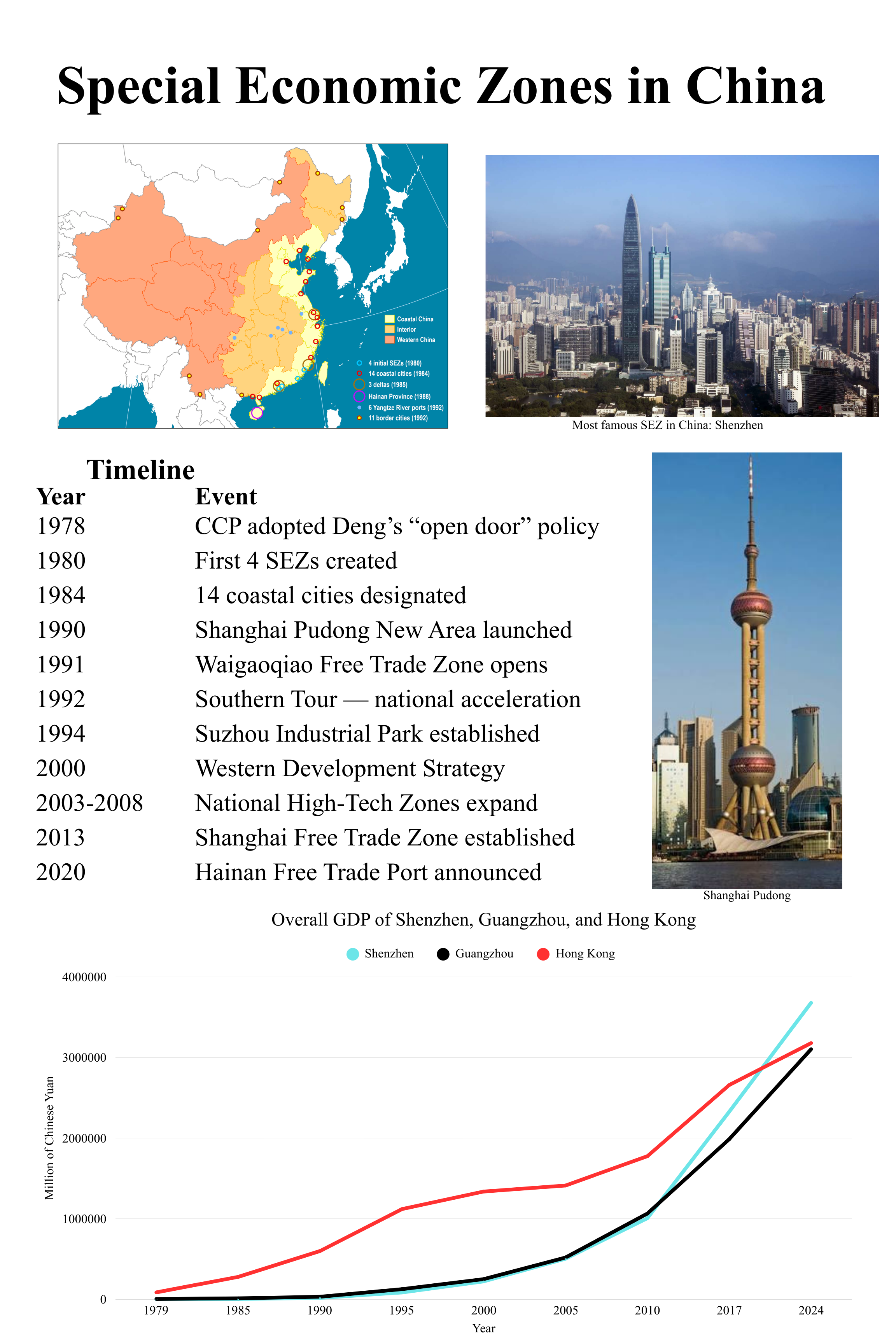
When China first opened its doors to the world in 1978, the country stood at a crossroad. The Chinese government made a significant decision to gain Foreign Direct Investment (FDI). The idea of small experimental zones along the coast emerged. These places were called Special Economic Zones (SEZs). The methods of SEZs attracting FDI were done by offering lower corporate income tax rates, access to talent, and intellectual property protection (Acclime China). The development of China’s SEZs began dynamically with the four earliest SEZs designated—Shenzhen, Xiamen, Shantou, and Zhuhai.
Shenzhen, once a fishing village, became the most successful result of the SEZs policy. Investors from all over the world rushed in. Factories were built one after another, skyscrapers rose where rice fields once stood, and new landmark structures appeared every several years. Shenzhen’s success strengthened the Chinese government’s confidence in the idea of SEZs. As a result, more and more zones with different purposes emerged, such as Free Trade Zones (FTZs) and High-tech Development zones (Cash).
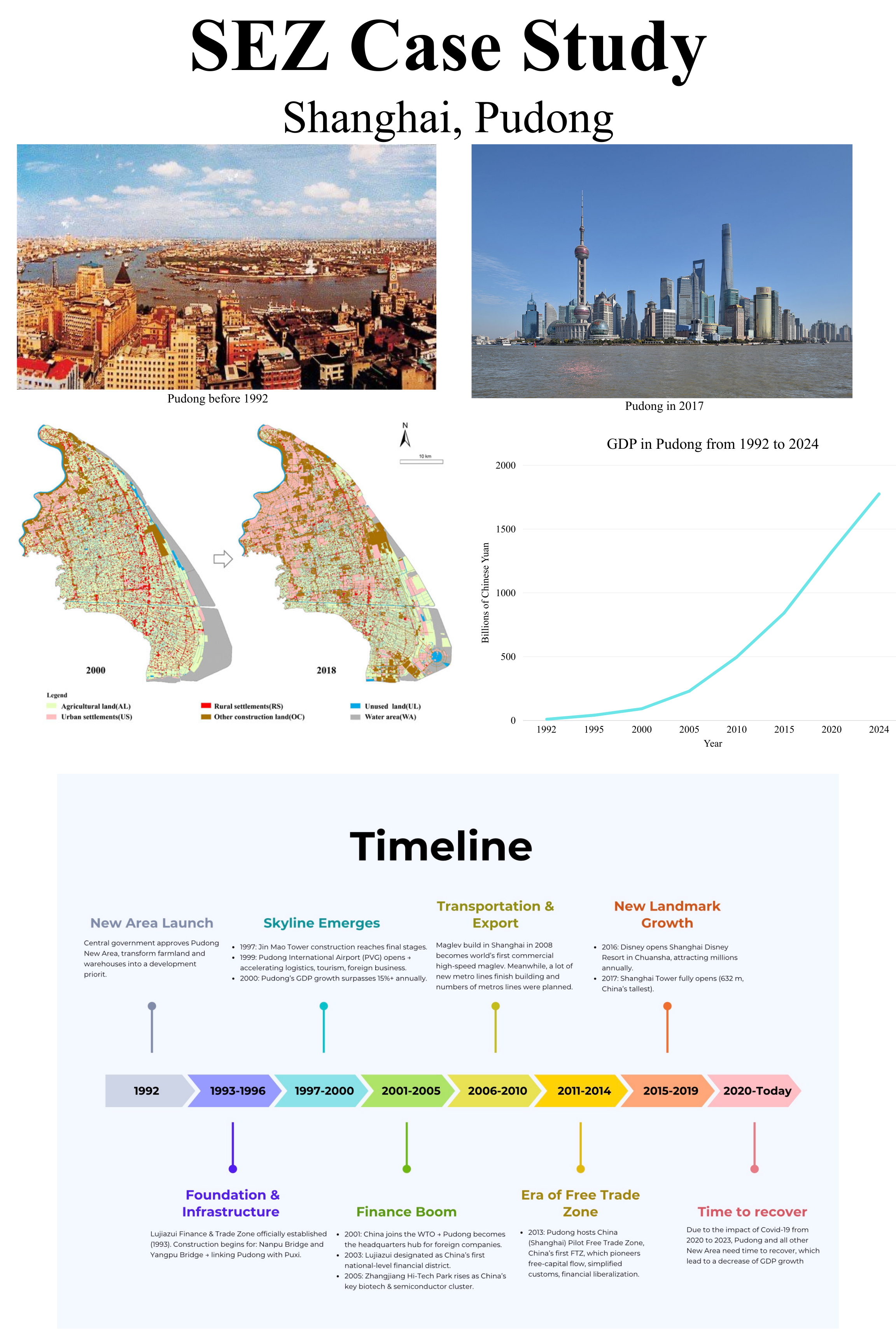
Among all these zones, Shanghai’s Pudong New Area stands as the most dramatic transformation of all. Shanghai can be clearly defined as two areas: Pudong and Puxi. Puxi is located to the west of the Huangpu River that flows through the city, while Pudong is to its east.. Before 1992, Pudong was regarded as a rural area by the people of Shanghai. Farmland and a few warehouses were people’s impression of Pudong. At that time, a saying was widely spreading, “Rather have a bed in Puxi than a whole house in Pudong.” However, everything changed when the approval of the Pudong New Area launched in 1992. Bridges spanned the Huangpu River, Liujiazui has transformed from a low-income area into China’s most important financial center, and the largest and busiest airport in China has also been constructed in Pudong. By the 2010s, Pudong had become a symbol of China’s rise: a forest of skyscrapers, a center of finance and technology, and a diverse area where Chinese and foreign cultures blend together.
Acclime China. “Special Economic Zones (Sezs) in China for Foreign Investment & Manufacturing.” Acclime China, 29 Nov. 2024, china.acclime.com/guides/special-economic-zones-foreign-investment-manufacturing/.
Cash, Joe. “China Launches $113 Billion Free-Trade Experiment on Hainan Island | Reuters.” Reuters, 18 Dec. 2025, www.reuters.com/world/china/china-launches-113-billion-free-trade-experiment-hainan-island-2025-12-18/.