Social Change
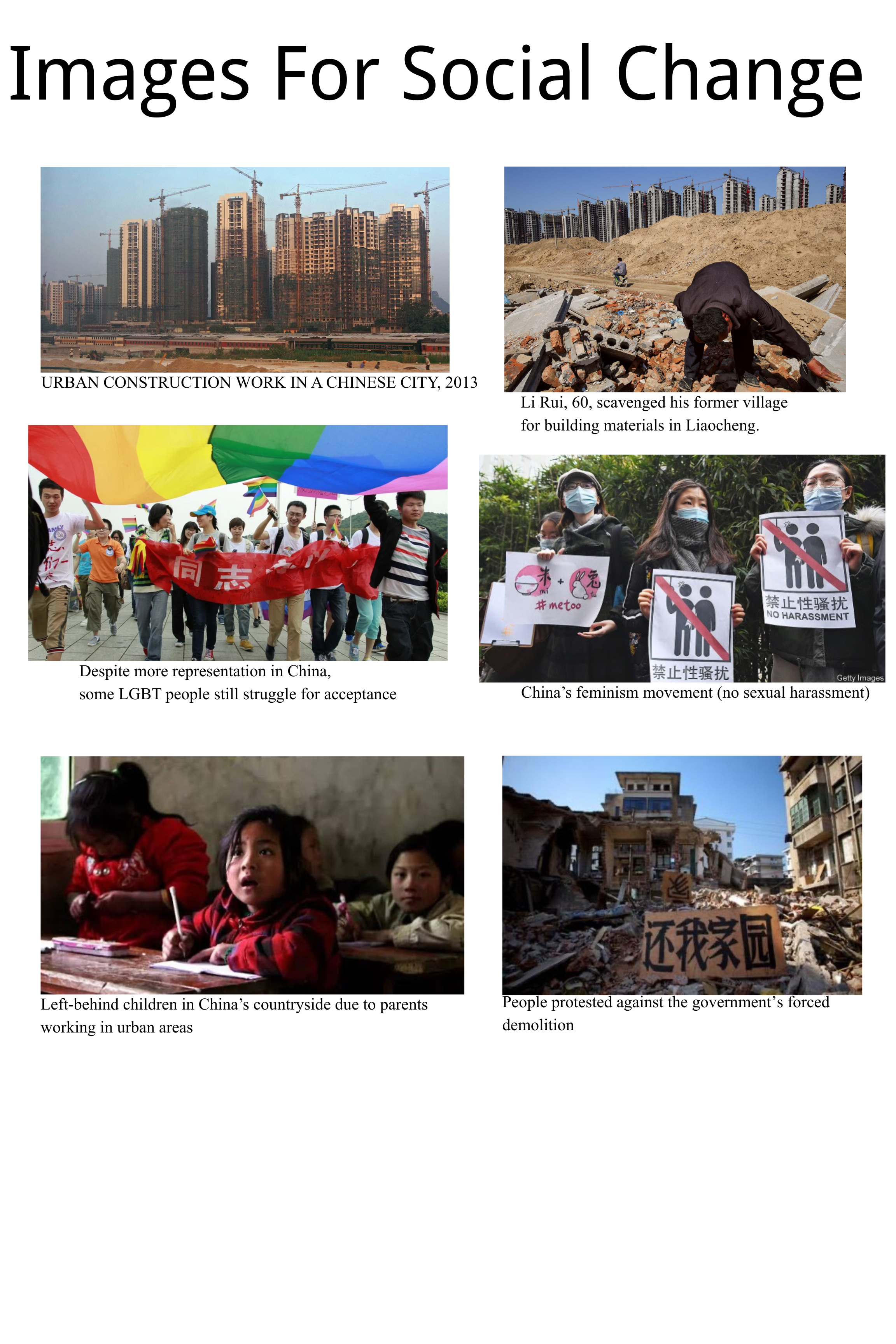
Since the launch of Reform and Opening up in 1978, China has undergone major social changes alongside rapid economic development. One of the most significant changes has been large-scale urbanization.
Rapid urbanization has transformed China’s physical and social landscape. Millions of people who lived in rural areas left their hometowns for cities to pursue a better life. In booming urban centers, new apartment towers symbolized opportunity and economic growth. However, the price of this prosperity is also heavy. Many old buildings were forcibly demolished and people had to leave their homes. For some villagers, like Li Rui scavenging bricks from his former home, development meant displacement and loss. Progress did not come without sacrifice (Li)
Social Change also reached families and relationships. As parents migrated for work, many children were left behind in rural villages,growing up without parents' care. These children’s growth will have great problems without the company of their parents (Stanford).
At the same time, new voices began to emerge. Young people marched under rainbow flags, seeking acceptance for LGBTQ communities. Women stood in public spaces holding signs against sexual harassment, challenging traditional Chinese norms. These movements showed a shift not just in policy, but in mindset—toward greater awareness of rights, equality, and individual identity (Fischer)
Overall, China’s social change since reform and opening up has been complex and uneven. While economic development has improved living standards for many, it also produced new social challenges.
Fincher, Leta Hong, et al. “China’s Feminist Five.” Dissent Magazine, 17 Oct. 2016, dissentmagazine.org/article/china-feminist-five/. Accessed 8 Jan. 2026
Li, Justin. “The Human Impacts of China’s New Urbanisation.” South China Morning Post, 11 Apr. 2016, www.scmp.com/magazines/post-magazine/article/1934172/photographs-human-impacts-chinas-new-urbanisation. Accessed 8 Jan. 2026
Stanford. “‘Our Parents Are All Gone’: Understanding the Impacts of Migration on a.” FSI, sccei.fsi.stanford.edu/reap/docs/left-behind-children-intern-introduction. Accessed 8 Jan. 2026.