State-Owned Enterprises and Privately-Owned Enterprise Development in China
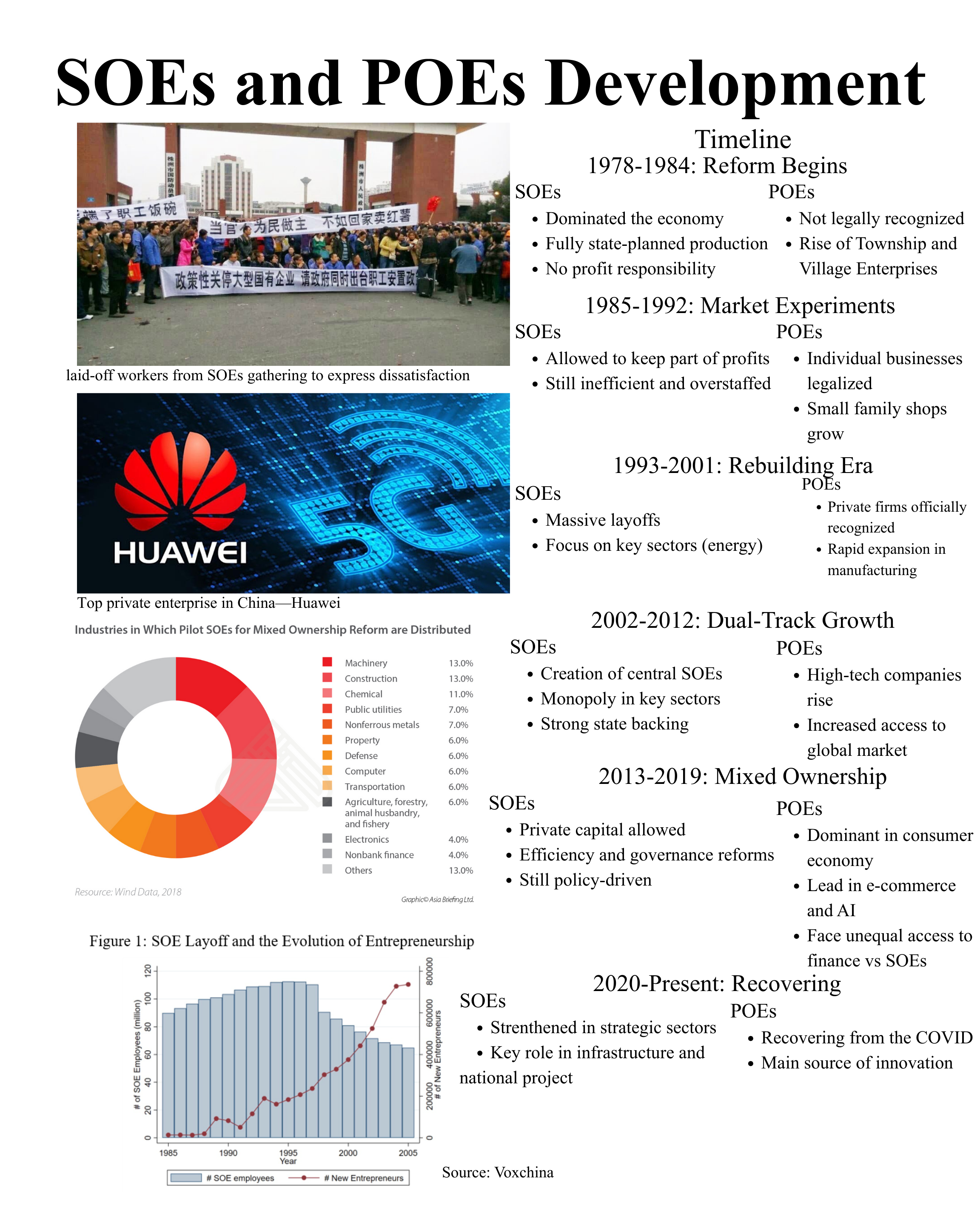
During the Reform and Opening Up period beginning in 1978, state-owned enterprises (SOEs) were at the core of the national economy. Before reform, SOEs operated under a planned system in which the government controlled product targets, prices and resources. Workers benefited from the “iron rice bowl,” which guaranteed lifelong employment, stable wages, and good treatment after retirement. However, this system caused problems such as low efficiency and weak incentives. Unless workers made serious mistakes, they would never be laid off. But the path to promotion was also blocked. Therefore, workers lost their enthusiasm (Kong).
With reforms promoted under Deng Xiaoping, SOEs gradually moved toward market-oriented mechanisms. In the 1980s, new policies allowed enterprises to keep part of their earnings and gave managers greater autonomy (Lin). In the 1990s, reforms deepened through corporatization, mergers, and partial privatization. Many inefficient SOEs were closed or reconstructed, leading to large-scale layoffs (Asian Monitor Resource Center) Instead, stronger SOEs consolidated their position in strategic sectors such as energy, telecom, transportation, and heavy industry. These reforms transformed SOEs into more commercially driven enterprises.
Private-owned enterprises (POEs) developed more gradually but became a powerful force in China’s economic transformation. In the early reform years, private business was tightly restricted and often politically sensitive. Most early private activity took the form of small household businesses and township and village enterprises (TVEs).
As reforms continued, the government slowly began to accept and protect private ownership. By the 1990s, private-owned enterprises grew quickly, especially in coastal areas, and became important sources of jobs, new ideas, and exports. Unlike state-owned enterprises, private firms did not receive strong government support or guaranteed welfare for workers (Knowledge at Wharton Staff). However, strong market competition pushed them to work more efficiently and adapt quickly. Together, SOEs and POEs formed a mixed economic system that supported China’s rapid economic growth during the Reform and Opening Up period.
Asian Monitor Resource Center. “Causes, Implementation and Consequences of ‘Xiagang.’” Asian Monitor Resource Center, 1 July 2006, amrcentre.org/causes-implementation-and-consequences-of-xiagang/. Accessed 13 Jan. 2026
Knowledge at Wharton Staff. “The Long and Winding Road to Privatization in China.” Knowledge at Wharton, Knowledge at Wharton, 10 May 2006, knowledge.wharton.upenn.edu/article/the-long-and-winding-road-to-privatization-in-china/. Accessed 13 Jan. 2026
Nancy, Kong. “Https://Www.Sciencedirect.Com/Science/Article/Abs/Pii/S1051200421000968 | Request PDF.” ScienceDirect, Sept. 2019, www.researchgate.net/publication/351163114_httpswwwsciencedirectcomsciencearticleabspiiS1051200421000968. Accessed 13 Jan. 2026
Lin, Yifu. “Https://Www.Sciencedirect.Com/Science/Article/Abs/Pii/S1051200421000968 | Request PDF.” ScienceDirect, Sept. 2021, www.researchgate.net/publication/351163114_httpswwwsciencedirectcomsciencearticleabspiiS1051200421000968. Accessed 13 Jan. 2026